If you use AI regularly, you have probably asked this question at some point:
Which is better: ChatGPT, Claude or Gemini?
It sounds like there should be a simple answer. Pick the best one, pay for one subscription, and get on with your work.
In practice, it is rarely that simple.
People who use more than one AI often discover something frustrating: the model that gives you an excellent answer today might completely miss the point on your next question. One may be better for a piece of writing, another may explain a complicated topic more clearly, and a third may notice something the others overlooked.
That is why the more useful question may not be “Which AI is best?”
It may be:
“Why should I have to choose only one?”
ChatGPT, Claude and Gemini are good at different things
Spend enough time with the leading AI assistants and their differences become noticeable.
ChatGPT is often the default for general-purpose AI use. People use it for everything from brainstorming and explanations to writing, analysis and everyday questions.
Claude has developed a strong reputation among people who care about writing, long-form work and thoughtful responses. Some users find that it follows tone and intent particularly well.
Gemini has its own advantages, particularly for people already working heavily within Google's ecosystem and for tasks where access to current information or Google services matters.
But none of that means one model simply wins every category.
Even people who pay for all three frequently describe switching between them depending on what they are doing.
And sometimes they use more than one for the same task.
The same prompt can produce very different answers
One of the easiest ways to see the difference between AI models is simply to give them the same question.
You might get three answers that broadly agree.
You might get three completely different approaches.
Or, more interestingly, you might get two answers that agree while the third notices an assumption or problem the others missed.
This matters because AI answers can sound extremely convincing even when they contain errors.
A polished answer is not necessarily a correct answer.
If ChatGPT confidently tells you something, asking Claude or Gemini the same question can sometimes reveal a disagreement you would never have noticed otherwise.
That is one reason many people end up developing a manual cross-checking workflow:
- Ask one AI.
- Copy the answer.
- Open another AI.
- Paste the question or previous answer.
- Ask whether it agrees.
- Repeat with a third model if the answer matters enough.
It works.
It is also tedious.
So which is better for writing?
There is no universal answer, but Claude is frequently praised for natural-sounding writing and its ability to follow tone closely.
ChatGPT remains extremely capable for drafting, rewriting and brainstorming, particularly when you give it clear stylistic instructions.
Gemini can also produce strong written work, and some users prefer it for particular professional or research-oriented workflows.
The important part is that these are tendencies, not laws.
A model that writes the best first draft of one article may not produce the best version of your next one.
For important writing, seeing how another model approaches the same passage can be surprisingly useful.
Which is better for research?
This is where relying on a single AI becomes particularly risky.
All major language models can produce incorrect information. They can misunderstand a source, make an unsupported assumption or state something uncertain with more confidence than it deserves.
For research that matters, you should still verify important claims against original or reliable sources.
But another AI can provide a useful second perspective.
If two models give you substantially different explanations of the same question, that disagreement itself is information.
It tells you:
“This is something worth checking.”
That can be far more useful than receiving one beautifully written answer and assuming it must be right.
Which is better for coding?
This is another category where opinions vary enormously.
One developer may swear by Claude. Another may prefer ChatGPT. Someone working inside Google's ecosystem may prefer Gemini.
And those preferences can change as the models themselves change.
That is an important point that gets lost in many AI comparisons.
The AI market moves extremely quickly.
A comparison declaring one model the clear winner can age badly within months.
Models are updated. Reasoning improves. Features change. Limits change. New versions arrive.
Choosing your entire workflow around whichever AI happens to be ahead today can therefore become frustrating very quickly.
There may not be one “best AI”
This is the part most comparisons miss.
ChatGPT vs Claude vs Gemini is usually treated like a competition where one model has to win.
But that is not necessarily how these tools are most useful.
Imagine asking three knowledgeable people the same difficult question.
You probably would not expect all three to give exactly the same answer.
One might notice a flaw in your assumption.
Another might explain the issue more clearly.
Another might disagree entirely.
The value comes partly from the differences between their perspectives.
AI can work the same way.
Instead of asking:
“Which AI should I trust?”
A better question may sometimes be:
“What do the different AIs think, and where do they disagree?”
The problem with manually comparing AI models
The obvious solution is to use all three.
But anyone who has actually tried doing this knows how awkward it becomes.
You ask ChatGPT something.
Then you open Claude.
You paste the question again.
Maybe you also paste ChatGPT's answer and ask Claude to critique it.
Then you open Gemini and repeat the process.
Now you have three separate conversations in three separate tabs, each with different context.
If the discussion continues, keeping everything synchronized becomes even more annoying.
And if you want the models to respond to each other's reasoning, you have to act as the messenger between them.
That was the problem we wanted to solve with Plurilog.
What if ChatGPT, Claude and Gemini could discuss the question together?
Plurilog takes a different approach.
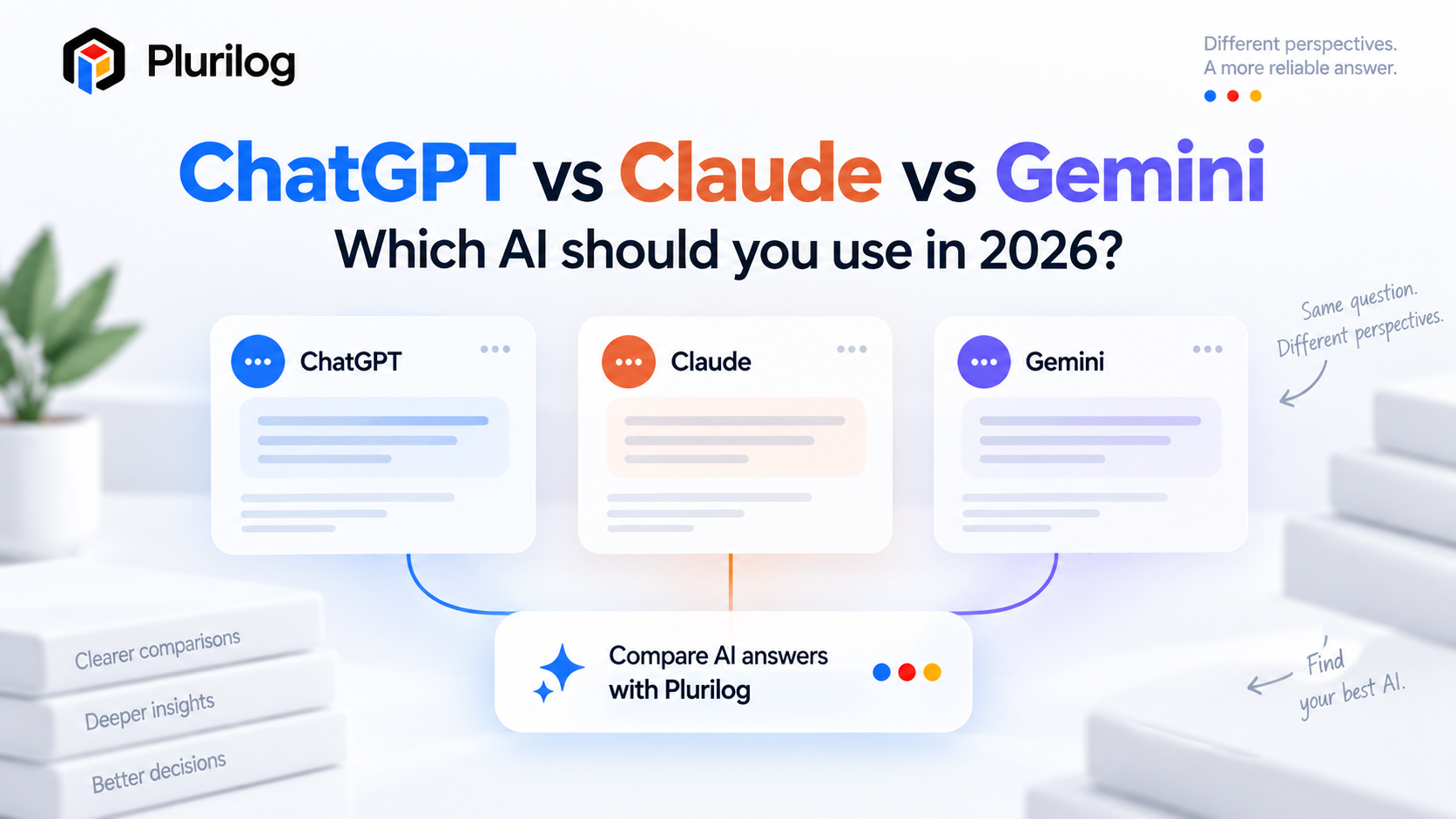
Instead of giving you a menu where you choose one AI to answer, it brings ChatGPT, Claude and Gemini into the same discussion.
You ask the question once.
Each model can see the conversation and what the other models have said.
That means one AI can agree with another, challenge a claim, notice something that was missed, or build on an earlier response.
It is closer to having an AI panel than switching between three separate chat windows.
You can also change which model responds first, reorder the panel or remove a model entirely when you do not need it.
And rather than maintaining separate paid subscriptions simply to use all three through their individual services, one Plurilog subscription gives you access to all three models inside Plurilog.
Does using multiple AIs guarantee a correct answer?
No.
Three AI models agreeing does not magically turn an answer into a fact.
Models can share similar training data, make similar assumptions and sometimes repeat the same mistake.
For anything important, you should still verify critical claims against reliable sources.
The benefit of multiple models is not certainty.
It is more scrutiny.
A second or third perspective can expose disagreements, weaknesses or assumptions that would otherwise remain invisible.
Think of it as another layer of checking, not a replacement for verification.
When comparing multiple AIs is especially useful
Using more than one model can be particularly valuable when:
- you are researching something where accuracy matters
- an answer sounds convincing but you are not completely sure it is correct
- you are making an important decision
- you want feedback on writing from different perspectives
- you are debugging a difficult problem
- one AI seems to have misunderstood your question
- you want to challenge an assumption rather than simply receive another answer
- you are tired of deciding which AI is supposedly “best” this month
For simple questions, one AI may be perfectly sufficient.
For harder questions, another perspective can be worth a lot.
ChatGPT vs Claude vs Gemini: the verdict
So which one should you choose?
ChatGPT? Claude? Gemini?
For some people, choosing one makes sense.
If one model consistently handles almost everything you need, there is little reason to complicate your workflow.
But if you already find yourself switching between them, cross-checking answers, or wondering whether another model would have caught something the first one missed, then forcing yourself to choose a single winner may not make much sense at all.
The three models do not have to compete for one seat.
Sometimes the better approach is to put them around the same table.
One conversation. Multiple perspectives. Better answers.
With Plurilog, ChatGPT, Claude and Gemini can respond inside the same discussion, see what the others have said, and challenge or build on each other's answers.