
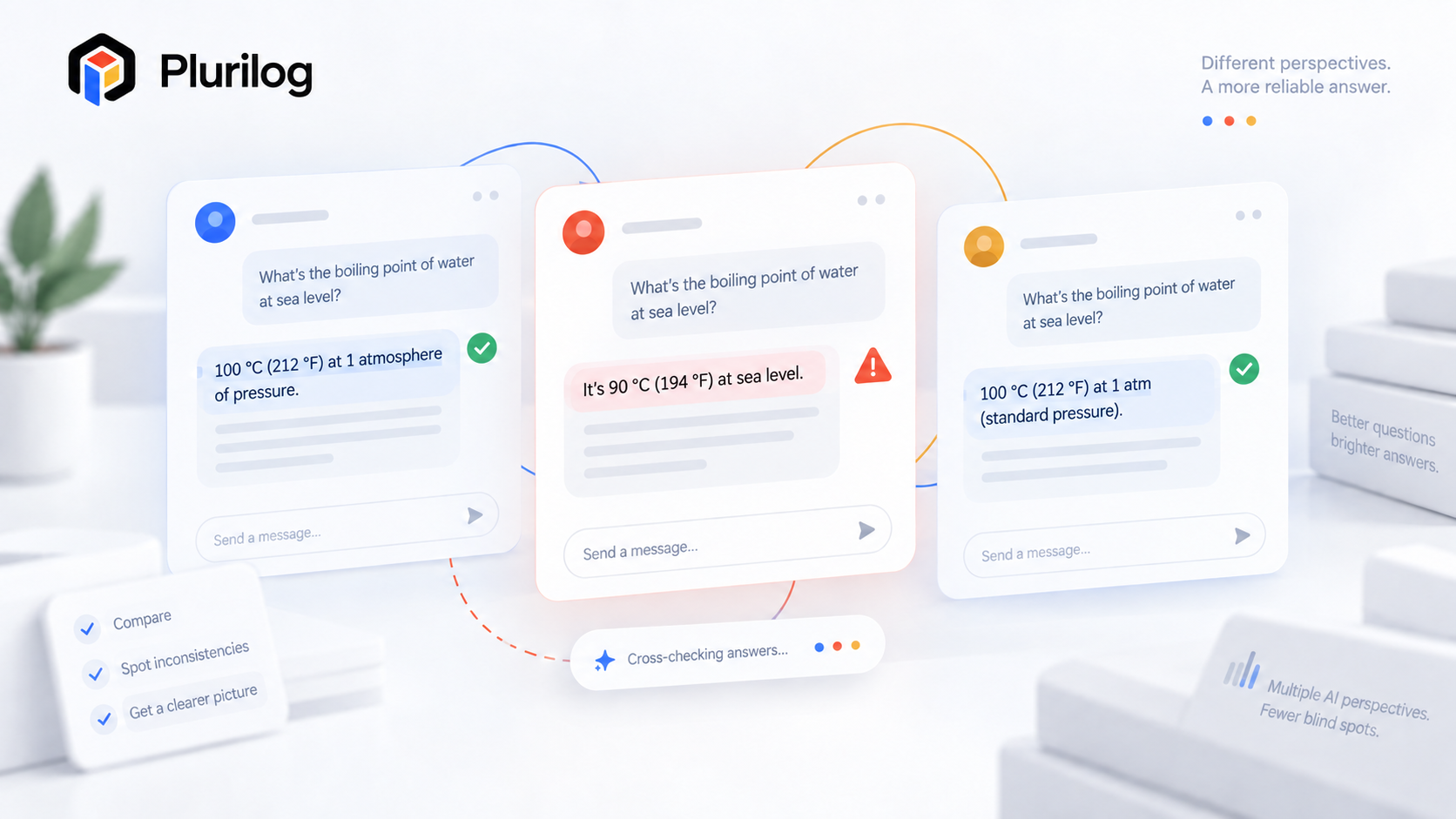
AI can write an email, explain a difficult concept, analyse a document, help debug code, or answer a question in seconds.
The problem is that it can also be completely wrong in seconds.
Worse, an incorrect AI answer does not necessarily look incorrect. It can be detailed, polished and delivered with exactly the same confidence as a correct one.
That problem is usually called an AI hallucination.
AI hallucinations are not limited to one chatbot. ChatGPT, Claude, Gemini and other large language models can all produce information that is inaccurate, unsupported or entirely invented.
And as more people use AI for research, writing, coding, studying, business decisions and everyday questions, knowing how to check an AI answer is becoming just as important as knowing how to ask one.
The useful question is no longer simply:
Can AI answer this?
It is:
How do I know whether this AI answer is actually right?
What is an AI hallucination?
An AI hallucination happens when an AI generates information that sounds credible but is false, invented or unsupported.
Sometimes the error is obvious.
More often, it is surprisingly believable.
An AI might:
- invent a publication that never existed
- attribute a quotation to the wrong person
- provide the wrong date or statistic
- describe a product feature that does not exist
- fabricate a citation or DOI
- misread information in a document
- combine several real facts into a conclusion that is still wrong
Research into generative AI has repeatedly documented fabricated references and other plausible-looking false information.
That is what makes hallucinations difficult to spot: they frequently arrive in exactly the same polished tone as accurate answers.
Why does AI sound confident when it is wrong?
Large language models are extremely good at producing plausible language.
That is not the same thing as having a perfect internal database of verified facts.
When a model has strong information and context, that ability can produce an excellent answer.
When information is incomplete, obscure, conflicting or uncertain, the same system can still generate an answer that looks like the answer that should exist.
This creates one of the strangest problems with generative AI:
fluency feels like authority.
A badly written answer naturally makes people suspicious.
A polished answer containing names, dates, numbers and citations often does the opposite.
But confidence is not evidence.
AI hallucinations are bigger than fake citations
Fabricated references are one of the easiest examples to demonstrate, but AI hallucinations can appear almost anywhere.
Ask an AI to compare two products and it may confidently invent a specification.
Ask it to explain a law or policy and it may give you outdated information.
Ask it to summarise a document and it may introduce a detail that was never in the document.
Ask about a recent event and it may blend current and outdated information together.
Hallucinations can affect:
- research
- software development
- statistics
- biographies
- business information
- legal questions
- product comparisons
- document analysis
- medical information
- everyday factual questions
That is why checking AI answers only when they already look suspicious is not enough.
The most dangerous hallucination is often the answer that gives you no reason to doubt it.
Can you just ask the AI to check itself?
You can.
Sometimes it will catch its own mistake.
But asking one AI whether its previous answer was correct is not the same thing as introducing an independent perspective.
The model may reconsider the answer.
It may also confidently defend the original mistake.
For questions that matter, a stronger approach is to compare how different AI models reason about the same problem.
Compare ChatGPT, Claude and Gemini instead of relying on one AI
Suppose ChatGPT gives you one answer.
Claude reaches a different conclusion.
Gemini notices an assumption neither of the other answers mentioned.
That disagreement is useful.
It tells you immediately that something deserves another look.
Even when the models broadly agree, seeing different reasoning paths can reveal assumptions, missing context and uncertainty that may be invisible in a single response.
This is the problem Plurilog is designed to solve.
Instead of opening ChatGPT, copying an answer, opening Claude, asking the question again, then opening Gemini and trying to keep three separate conversations straight, Plurilog brings ChatGPT, Claude and Gemini into one ongoing AI discussion.
The models share the discussion context and can work with the same documents and images.
They can also respond after seeing what has already been said in the discussion.
That makes comparing AI answers part of the conversation instead of a separate chore.
Does using multiple AI models eliminate hallucinations?
No.
Three AI models agreeing does not magically turn an answer into a verified fact.
Different models may rely on similar information, make similar assumptions or miss the same thing.
Plurilog is not designed around the idea that majority vote equals truth.
The advantage is visibility.
A single AI can confidently give you one interpretation with no indication that another reasonable interpretation exists.
With multiple models in the same discussion, disagreements, assumptions and blind spots are much easier to expose.
That gives you more information before you decide what to trust.
How to fact-check an AI answer
For anything important, combine AI comparison with actual evidence.
1. Identify the claims that can be checked
Look for:
- names
- numbers
- dates
- quotations
- citations
- product specifications
- factual claims
- legal or regulatory statements
Those are the parts of an answer most suitable for direct verification.
2. Compare another perspective
Ask another AI model the same question.
If it gives a materially different answer, investigate the disagreement instead of simply choosing the answer you prefer.
3. Ask why the models disagree
Differences are often more useful than agreement.
One model may be interpreting the question differently.
Another may know about an exception.
Another may be relying on outdated information.
Understanding the reason for disagreement can reveal the real issue.
4. Check the primary source
For decisions that matter, verify important claims against the best available evidence:
- official documentation
- original research
- government sources
- company documentation
- published datasets
- primary records
AI comparison helps expose potential errors.
It does not replace evidence.
When multiple AI perspectives are especially useful
Cross-checking AI is useful whenever the answer requires more than a simple lookup.
Research
One model may suggest an interpretation or source that another model challenges.
Writing
One AI may improve structure while another catches an unsupported claim or weak argument.
Coding
Different models can propose different causes for a bug or different ways to implement a solution.
Documents
ChatGPT, Claude and Gemini can examine the same uploaded material while keeping the surrounding discussion in context.
Images
The models can analyse the same screenshots, photographs or diagrams and compare what they notice.
Decisions
When there is no single obvious answer, seeing multiple approaches can reveal trade-offs that one model alone may overlook.
Why cross-checking AI should be easier
People already cross-check AI manually.
They ask ChatGPT a question.
Then they paste the same prompt into Claude.
Then Gemini.
Then they compare three browser tabs, three conversation histories and three slightly different versions of the original question.
That works.
It is also unnecessarily awkward.
Plurilog turns that process into one conversation.
You ask once.
The AI panel responds in sequence.
Each model receives the shared discussion context.
Documents and images stay available within the discussion.
And instead of manually recreating the same conversation across several AI products, you can focus on the differences between the answers.
Can you trust AI answers?
AI can be extraordinarily useful without being automatically trustworthy.
Those two ideas are not contradictory.
The goal is not to stop using AI.
It is to stop confusing a confident answer with a verified one.
Use AI for:
- speed
- synthesis
- exploration
- brainstorming
- analysis
- alternative perspectives
But when the answer matters:
challenge it.
Ask another model.
Look for disagreement.
Check the evidence.
And make uncertainty visible before acting on the answer.
Frequently asked questions about AI hallucinations
What is an AI hallucination?
An AI hallucination is information generated by an AI system that sounds plausible but is false, inaccurate or unsupported.
Does ChatGPT hallucinate?
Yes. Like other large language models, ChatGPT can generate incorrect or fabricated information. The likelihood depends on the question, available context and the kind of information being requested.
Do Claude and Gemini hallucinate too?
Yes. AI hallucinations are not unique to one provider or model family. Claude, Gemini and other generative AI systems can also produce incorrect answers.
Which AI model is the most accurate?
There is no single model that is most accurate for every subject and every task. Model performance varies by question, context, available tools and model version.
Can comparing several AI models prevent hallucinations?
It cannot guarantee correctness, but comparing multiple models can expose disagreements, assumptions and potential errors that may remain hidden when relying on only one answer.
How should I fact-check an AI answer?
Compare perspectives, identify checkable claims, and verify important information against reliable primary sources.
Further reading
Get more than one AI's point of view
Bring ChatGPT, Claude and Gemini into one ongoing discussion with shared context, documents and images. Compare perspectives, uncover blind spots and make questionable answers easier to catch.